
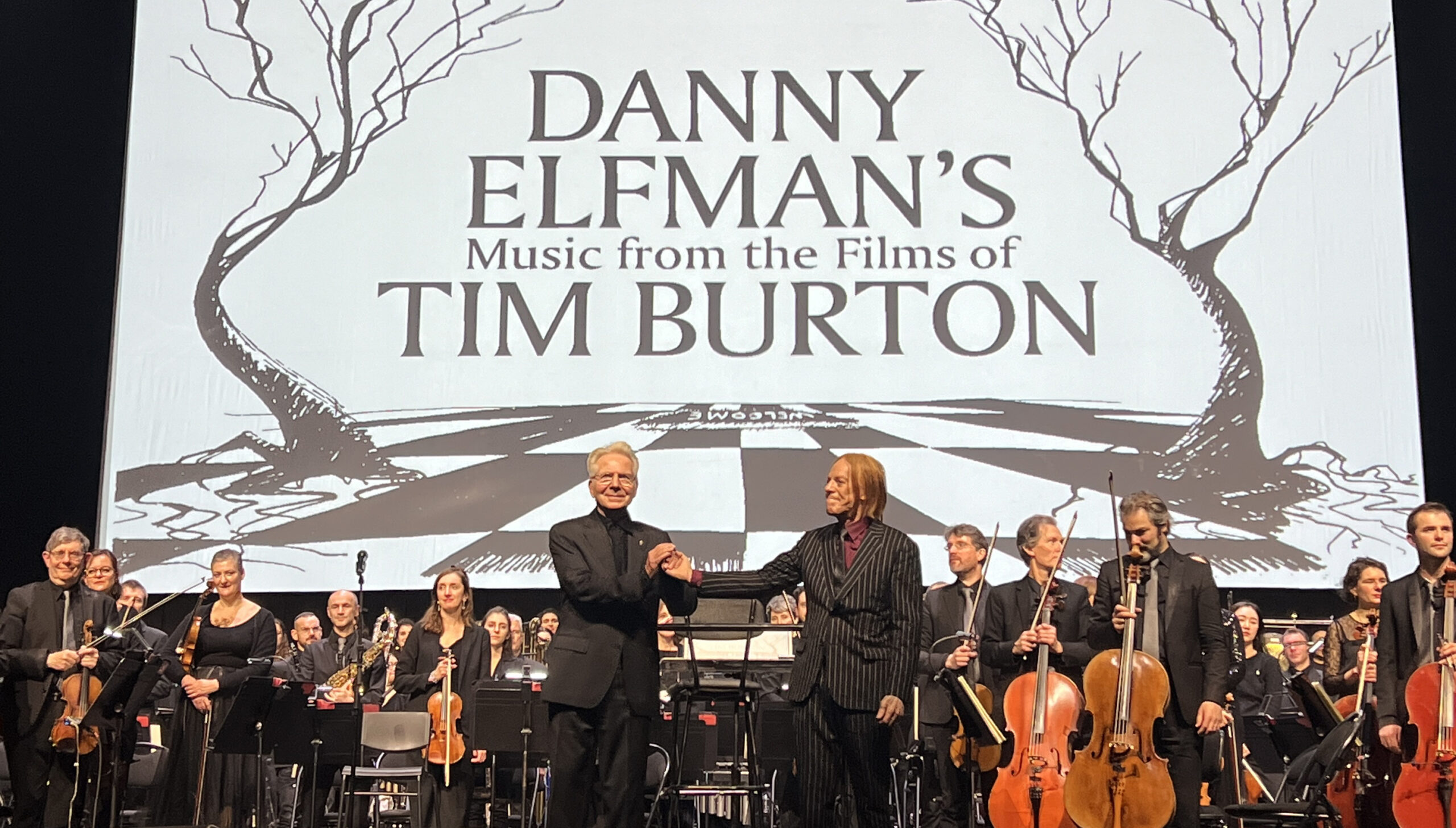
Burton gives blood to ‘Sweeney’

Film is first musical for helmer

(Lire la suite…)

  • Voter :
    1 Star2 Stars3 Stars4 Stars5 Stars (Pas de votes)
    Loading ... Loading ...
  • 0 Comments
  • Filed under: Sweeney Todd
  • Christophe S. nous fait parvenir son travail de fin d’Ă©tudes, La mort mise en scĂšne au cinĂ©ma : Une rĂ©flexion Ă  travers l’Ɠuvre de Tim Burton.

    Il a l’amabilitĂ© de nous le faire parvenir et de nous proposer de le diffuser !

    [...]Et aussi parce que je me suis un peu servi de ton site pour le réaliser, entre autres pour des éléments de biographie, pour la filmo et pour des citations par ci, par là. Tu es bien sûr cité dans mes sources.

    Je ne l’ai pas (encore) lu complĂštement, mais il prĂ©sente le rĂ©alisateur, met en relation sa carriĂšre au cinĂ©ma avec sa vie professionelle film Ă  film, et approfondit les films Beetlejuice et Corpse Bride (thĂ©matiques, etc etc).  Danny Elfman y est aussi prĂ©sentĂ©.

    Le dossier fait 94 pages et semble trĂšs bien fait ! (sources prĂ©sentes,etc -j’y suis crĂ©ditĂ© en tant que LACHANCE Gordie ;) ).

    Bref, ça vaut le détour !

    La mort mise en scĂšne au cinĂ©ma: Une rĂ©flexion Ă  travers l’oeuvre de Tim Burton

    Tim Burton sur Mars Attacks!

    Mercredi 22 janvier 97. La nuit tombe sur Hollywood dĂ©jĂ  gris sous l’orage. Le mythique ChĂąteau-Marmont, tel le chateau du comte Dracula, surplombe toujours Sunset Boulevard. La pluie gouttant sur ses angles rappelle, au choix, l’antre de la famille Addams ou celle d’Edward aux mains d’argent. On comprend pourquoi Tim Burton et sa compagne et belle Martienne Lisa Marie y ont Ă©lu domicile. Nous dĂ©barquons avec quelques accessoires de Mars Attacks! « volĂ©s » dans l’aprĂšs-midi Ă  la Warner. Pendant le dĂ©chargement, Rosanna Arquette dĂ©boule avec son Ă©norme 4×4 et manque de nous Ă©crabouiller sans mĂȘme s’en apercevoir. Dans la cuisine, Lisa Marie se laisse maquiller, coiffer, pomponner pendant deux heures par ceux qui l’ont dĂ©jĂ  transformĂ©e en Martienne pour Mars Attacks! Tim dĂ©barque enfin, avec leur chihuahua du Japon (lui aussi star dans le film). Les blagues fusent sur le quadrupĂšde miniature arpentant hystĂ©riquement mais prudemment chaque recoin et chaque occupant de la piĂšce. Un martien est suspendu au plafond, et la chaine HiFi, seule rescapĂ©e du chambardement, crache les remix mĂ©talliques de Björk sous les spots Ă©blouissants, rouges, verts et blancs de StĂ©phane Sednaoui. Tim et Lisa s’assoient silencieusement devant une tĂ©lĂ© eteinte. Ils se sussurent des mots doux et se lancent des clins d’oeil. La veille, Tim nous avait parlĂ© de son dernier film, nĂ© d’une sĂ©rie de cartes Ă  collectionner des annĂ©es 60, l’occasion pour lui de conjuguer son talent de dessinateur (il a dĂ©butĂ© chez Disney) avec sa sympathie pour « le plus mauvais rĂ©alisateur du monde » et hĂ©ros de son film prĂ©cĂ©dent: Ed Wood.

    (Lire la suite…)

  • Voter :
    1 Star2 Stars3 Stars4 Stars5 Stars (Pas de votes)
    Loading ... Loading ...
  • 0 Comments
  • Filed under: Mars Attacks!
  • Passage Ă  Venise, deux journĂ©es, pour rencontrer Tim Burton et voir quelques minutes de son nouveau film, « Sweeney Todd« , avec Johnny Depp et Helena Bonham Carter, qui sortira le 21 dĂ©cembre aux Etats-Unis, puis en janvier en France. Je dois en effet ajouter un nouveau chapitre Ă  mon livre sur l’auteur d’ »Edward aux mains d’argent » pour une réédition Ă  paraĂźtre Ă  l’automne.
    (Lire la suite…)

  • Voter :
    1 Star2 Stars3 Stars4 Stars5 Stars (Pas de votes)
    Loading ... Loading ...
  • 0 Comments
  • Filed under: Sweeney Todd
  • The 3D Magic of Nightmare Before Christmas

    8330|400

    A landmark film in its genre, the 1993 release of THE NIGHTMARE BEFORE CHRISTMAS combined the power, enchantment and artistry of stop-motion animation with technological wizardry to create a moviegoing experience that captured the hearts and imaginations of millions of die-hard fans. It simultaneously became an all-time family favorite and attained permanent cult status among the cool. Just as its playful, pitch-perfect sense of Halloween fun made it a holiday standard, its mischievously dark humor and no-holds-barred creativity has made it an enduring video hit among college kids and hipsters — who admire it, quote it, sing it and even dress the parts at Halloween. For years, every Halloween has been turned into NIGHTMARE season at Hollywood’s legendary El Capitan Theatre, which screens the film each October to ever-growing audiences.

    Part ghostly love story, part upside-down holiday celebration and part toe-tappingly offbeat musical, this NIGHTMARE was always multidimensional. But now, the classic film that had audiences falling in love with one of the most painstakingly handmade of all animation processes has been brought hurtling into the 21st century and transformed for a new generation to experience in Disney Digital 3Dℱ, expanding its legacy of innovation.

    “This was a very special project for us—lending exciting new life to a film and characters that continue to be a tremendous success,” says Don Hahn, an Oscar¼-nominated producer (“Beauty and the Beast,” “Lion King”) and the producer of THE NIGHTMARE BEFORE CHRISTMAS 3D. “Audiences have long associated 3D with a story that is fun, scary or both, and with this film, they get it all. You feel like you’re right there in that amazing world with the puppets, not merely watching the story go by on the screen. When the snow falls, it’s falling right on you. When a character jumps out, he jumps over the head of the person in front of you. It literally brings an extra dimension to what has become a modern holiday classic.”

    Hahn continues: “THE NIGHTMARE BEFORE CHRISTMAS was part of the Golden Age of Animation in the early 1990s, during the period when Disney was also doing ‘Aladdin’ and ‘The Lion King.’ It became its own unique part of Disney’s animation heritage—a haunted-house Halloween movie with a wonderful heart, a Broadway-style musical for families, and a beautiful example of how stop-motion animation can work for audiences. Back then, it already had such an unusual and risk-taking combination of elements, adding the new, technologically advanced digital 3D into the mix seemed entirely natural.”

    8333|200
    8335

    Long before embarking on the project, Disney executives asked their partners in Digital 3D at Industrial Light & Magic to do a test run—digitizing a brief snippet of the film to see if the idea would sink or soar. The results were, in turn, screened for Tim Burton.

    His response was effusive. “What’s amazing is that because of the 3D process, audiences will really get to see the texture of the puppets,” Burton says. “When we were making the movie, we got to feel in our hearts like our characters were real—when you see it in 3D; it just takes it that much further. Everything comes to life, and you can literally see in through the eye sockets of Jack Skellington.”

    Meanwhile, when director Henry Selick first heard about the idea, he admits he was, well, a little spooked and quite skeptical—which made him even more surprised when he was completely won over by ILM’s work. “I honestly wasn’t too excited about the idea at first because, as amazing as modern technology is, I was concerned that it wouldn’t look good, that it would be a kind of Frankenstein’s monster,” Selick comments. “I was afraid it would come off looking like a bunch of cut-outs and disconnected layers.”

    “But as they began to show me more footage, my jaw started to drop. I was astonished by what they were achieving,” Selick continues. “They were being incredibly respectful of the original material, and it wasn’t gimmicky at all. Even though the technology is incredibly advanced, they were managing to really keep intact the handmade quality of the film. It actually took me back to how exciting it was when we were first making the film years ago and all these characters started to come to life.”

    8337

    Indeed, 3D is currently undergoing an extraordinary resurgence, thanks to the latest technological advances which have been seen in special versions of such films as “Chicken Little” and “Superman Returns.” The concept of 3D movies first emerged in Hollywood in the 1920s but didn’t take off until the 1950s with the advent of stereoscopic horror films such as “The House of Wax,” “Bwana Devil” and “The Creature From the Black Lagoon.” Audiences loved the idea of having a film’s action pop out right at them, but not the reality, which, unfortunately, was plagued by “ghosting”—in which two images blur on the screen—which could cause annoying and uncomfortable eye strain.

    8339|400

    Now, in the brave new world of digital cinema, 3D has finally come of age. A new generation of digital tools has revolutionized 3D viewing, creating a more seamless illusion for the audience. Disney Digital 3Dℱ was one of the first out of the gate, presenting a state-of-the-art system that combined the expertise of both ILM and Dolby Laboratories to offer unprecedented clarity, comfort, image integrity and a totally immersive film experience. Family audiences flocked to see the 3D version of “Chicken Little,” proving that the concept of 3D is now more appealing than ever as it achieves its real potential.

    In theory, all 3D films work by projecting a double image—one for the right eye and another for the left, which creates the rich sensation of real-life depth. Traditionally, this was achieved by using two projectors. Disney Digital 3Dℱ, however, takes it to another level by using just one projector, which rapidly shifts between images for the left eye and the right eye, so quickly (144 times per second) that the brain is not even aware of it. Using polarized light the images are crisper and clearer than any 3D process in history.

    But so far, the only films to be seen in their entirety in Digital 3D have been those that were digitally created in the first place. With THE NIGHTMARE BEFORE CHRISTMAS 3D, the unprecedented challenge would be to take the 2D, flat world of the original and give it the depth and dimension of Digital 3D—without, in any way, altering its innate charms. The first step in the process was to digitize the film— re-animating a “proxy” version of the entire movie in CG—a vast undertaking that fell to Industrial Light & Magic, under the supervision of ILM’s executive in charge of production, Colum Slevin.

    For Slevin and his team, the project was irresistible. “I don’t know of another instance like this where an analog film was transformed into a digital film. The processes were a real breakthrough for us, and we thrive on those sorts of big challenges,” he says. “It was incredibly tough, but it was also unbelievably rewarding because we were taking everything to the next level.”

    The team’s adoration of the original NIGHTMARE further amplified their excitement. “Everyone at ILM is a big fan of this movie. We were already in love with the project before we began,” notes Slevin.

    8341|200

    “It’s such a cool film and everybody kept saying, ‘It’s perfect for 3D!’ It’s so beautifully composed, the sets are gorgeous and there’s this quirky forced-perspective thing going on that already has a kind of 3D feel about it. In fact, once we began rendering the characters in 3D, they looked so fantastic, we felt it was just destined to be viewed this way.”

    Starting with a crew of 20 and eventually ramping up to 80, it took 19 very intense weeks of work for ILM to complete the transformation of NIGHTMARE. During this process, automatic tools were used to replicate the original film’s camera motions, sets were turned into digital models and a crew of animators was recruited to hand-animate the CG characters on a frame-by-frame basis, so their digital doubles matched the original camera photography. Once the geometry was forged for the sets and characters, special-effects artists used the computer to map the original film image directly onto the CG-animated geometry. Then the virtual camera, shifted slightly to the right, recorded a new camera angle for the right eye.

    Ultimately, audiences will unwittingly be seeing the original NIGHTMARE with their left eyes while seeing the digital re-creation with their right eyes, allowing for the three-dimensional effect.

    8343|400

    To begin with, the process required lots of digging into history. “We used a lot of archival lens information from Disney and we dug up all the original puppets so we could photograph them and create computer graphic models of each,” Slevin explains. “The original sets no longer exist but we were able, with digital tools, to take a sequence of images and infer the volume of each set from the still frames. So we could infer things like this floor is at a 45-degree angle and this chair is three feet from the wall, and then we could create an accurate blocking of the original sets in CG. It’s all basically geometry.”

    Digitizing the characters in all their stylized movement was the crux of the project. Slevin continues: “With stop-motion, you have to pose every single frame and every single frame is incredibly deliberate. So when you try to track and follow a character that’s been stop-motion animated, and you’re trying to replicate that in CG, you have to redo all that labor all over again from scratch, because there’s just no automatic way to do it. So there was a lot of blood, sweat and tears that went into replicating the performances authentically so the stereo would pick up faithfully in the right eye when we reprojected the original performances.”

    Yet even as the high-tech proceedings kicked into a higher gear, there was a constant emphasis on maintaining the film’s inimitably funky, scary-funny aesthetic with complete integrity. “Early on, I spoke to Henry Selick and we talked about what was possible, because once a film is digitized, there are no limits,” recalls Don Hahn. “So we could have changed anything, but the decision was made to keep that loving, handmade aspect of the film’s charm completely intact. So we didn’t even erase wires or shadows or alter any original mistakes. We really tried to be completely true to the original and not introduce anything artificial, but rather simply bring new dimensions to what was already there, with wonderful results.”

    Adding to the pressure to do right by the film was the fact that several of the staff at ILM had actually worked on the original release of NIGHTMARE. Slevin notes that his team developed a very helpful, oftrepeated mantra during the entire process —“Keep your filthy hands off the film”— to avoid any temptation to alter what had been created more than a decade ago by the impassioned original team of animators. “This was not a fix-it job,” he notes. “The grit and grain, the pops and errors and the ‘happy accidents’ of stop-motion animation are all still a part of the heart of the film.”

    8345|400

    For Henry Selick, that decision was very gratifying. “It seems that people these days are often trying to make films that are more and more slick—so for the handmade quality of our film to be a priority was just wonderful,” he says. “The 3D simply brings the audience further into the film’s environment. It reveals a side of the film that no one has ever seen before.”

    The only creative choices the team behind THE NIGHTMARE BEFORE CHRISTMAS 3D did make concerned where the action should be placed in the plane of depth to best serve the story. For example, the average distance between human eyes is about 2.5 inches. But that distance can be played with — stretched or shrunk — to create a particular 3D effect, such as allowing the audience to see the world from Jack Skellington’s skewed point of view. The team also decided which elements would appear in the foreground and background for virtual immersion, turning the 3D effect into a storytelling tool that guides the eye from one important detail to the next.

    “We worked out an entire stereo script with Don Hahn and the guys at Disney,” Slevin explains, “where they would say, ‘This is where the effect needs to be cranked up, and this is where you can ease off and dial the intensity back.’ Everything had to be completely in sync with the score and especially the storytelling, because it’s all about the story. That’s where the real magic is.”

    And Tim Burton agrees, “Turning THE NIGHTMARE BEFORE CHRISTMAS into Digital 3D has taken a very pure little gem for me and made it that much better. I am extremely happy about the fact that the movie has kept its purity and the 3D actually adds much more to it.”

  • Voter :
    1 Star2 Stars3 Stars4 Stars5 Stars (Pas de votes)
    Loading ... Loading ...
  • 0 Comments
  • Filed under: 3D
  • Le Parfum des RĂ©miniscences

    En 1799, Ichabod Crane est envoyĂ© Ă  Sleepy Hollow, en Nouvelle Angleterre, pour enquĂȘter sur une sĂ©rie de meurtres. Des corps sont retrouvĂ©s dĂ©capitĂ©s, les tĂȘtes demeurant introuvables.
    (Lire la suite…)

  • Voter :
    1 Star2 Stars3 Stars4 Stars5 Stars (Pas de votes)
    Loading ... Loading ...
  • 0 Comments
  • Filed under: Sleepy Hollow
  • Big Fish – Tim Burton

    Qu’est-ce que « Big Fish » ? Un puzzle Ă  reconstituer et Ă  parfaire. La mise en chantier et en images de rĂ©cits, transmis du pĂšre au fils. EngouffrĂ© dans ses histoires, amoureux de sa dĂ©votion Ă  l’imaginaire, le pĂšre devient un dĂ©miurge qui immobilise temps et espace. Un cinĂ©aste, Tim Burton. « Big Fish » s’étire alors dans une parenthĂšse centrale oĂč coulissent les rĂ©cits, comme autant de graines jetĂ©es sur le chemin de la vie.
    (Lire la suite…)

  • Voter :
    1 Star2 Stars3 Stars4 Stars5 Stars (Pas de votes)
    Loading ... Loading ...
  • 0 Comments
  • Filed under: Big Fish
  • Hey folks, Harry here…. With NIGHTMARE BEFORE CHRISTMAS getting the 3D treatment this weekend – Disney set me up to interview Tim Burton… someone that I’ve wanted to talk to for a very very long time. Burton is just someone that loves many of the same classic old films and quirks of the past that many folks like me share. We float all over the place here, but specifically – we’re having the most fun talking about 3D, Vincent Price, Hammer Films, Johnny Eck, etc… Enjoy this interview, I know I did…

    (Lire la suite…)

    Visages de mort

    Tim Burton affectionne les masques. Il s’en amuse et en use. A l’instar de ses crĂ©ations, il aime Ă  se cacher, Ă  revĂȘtir quelques oripeaux trompeurs destinĂ© Ă  dissimuler son Moi profond. Aussi, s’il ne renie pas son statut de cinĂ©aste hollywoodien, son vĂ©ritable caractĂšre est ailleurs. L’anarchisme et la noirceur d’inspiration romantique qui innervent ses films s’expriment ainsi Ă  travers une forme chatoyante et spectaculaire que seule la toute puissance des studios lui permet de mettre en oeuvre. En cela, il semble proche d’un Vincente Minelli qui, peut-ĂȘtre, n’aurait reniĂ© ni Edward aux mains d’argent ni Sleepy Hollow. Mais cette magnificence a un prix. Elle implique un pacte faustien, un contrat en lettres de sang oĂč l’Ăąme risque d’y trouver sa perte. Et ce n’est pas parce que Burton manipule depuis longtemps ces rĂšgles qu’il est Ă  l’abri d’un faux pas. Cette PlanĂšte des singes est malheureusement lĂ  pour nous le rappeler.
    (Lire la suite…)

  • Voter :
    1 Star2 Stars3 Stars4 Stars5 Stars (Pas de votes)
    Loading ... Loading ...
  • 0 Comments
  • Filed under: Planet Of The Apes
  • PlanĂšte perdue

    Projet intriguant dans le parcours de Tim Burton (plutĂŽt habituĂ© aux loosers attachants qu’aux personnages de sauveurs de l’humanitĂ©), l’adaptation cinĂ©matographique de La PlanĂšte des Singes provoque une dĂ©ception Ă  la mesure des espoirs qu’on plaçait dans le pĂšre de quelques-uns des plus beaux freaks des ces derniĂšres annĂ©es : Edward aux mains d’argent, le Joker, Catwoman, jusqu’aux monstres du cinĂ©ma d’Ed Wood, et les Martiens de Mars Attacks.
    (Lire la suite…)

  • Voter :
    1 Star2 Stars3 Stars4 Stars5 Stars (Pas de votes)
    Loading ... Loading ...
  • 0 Comments
  • Filed under: Planet Of The Apes
  • Se connecter


    Newsletter

    ChargementChargement


    Archives